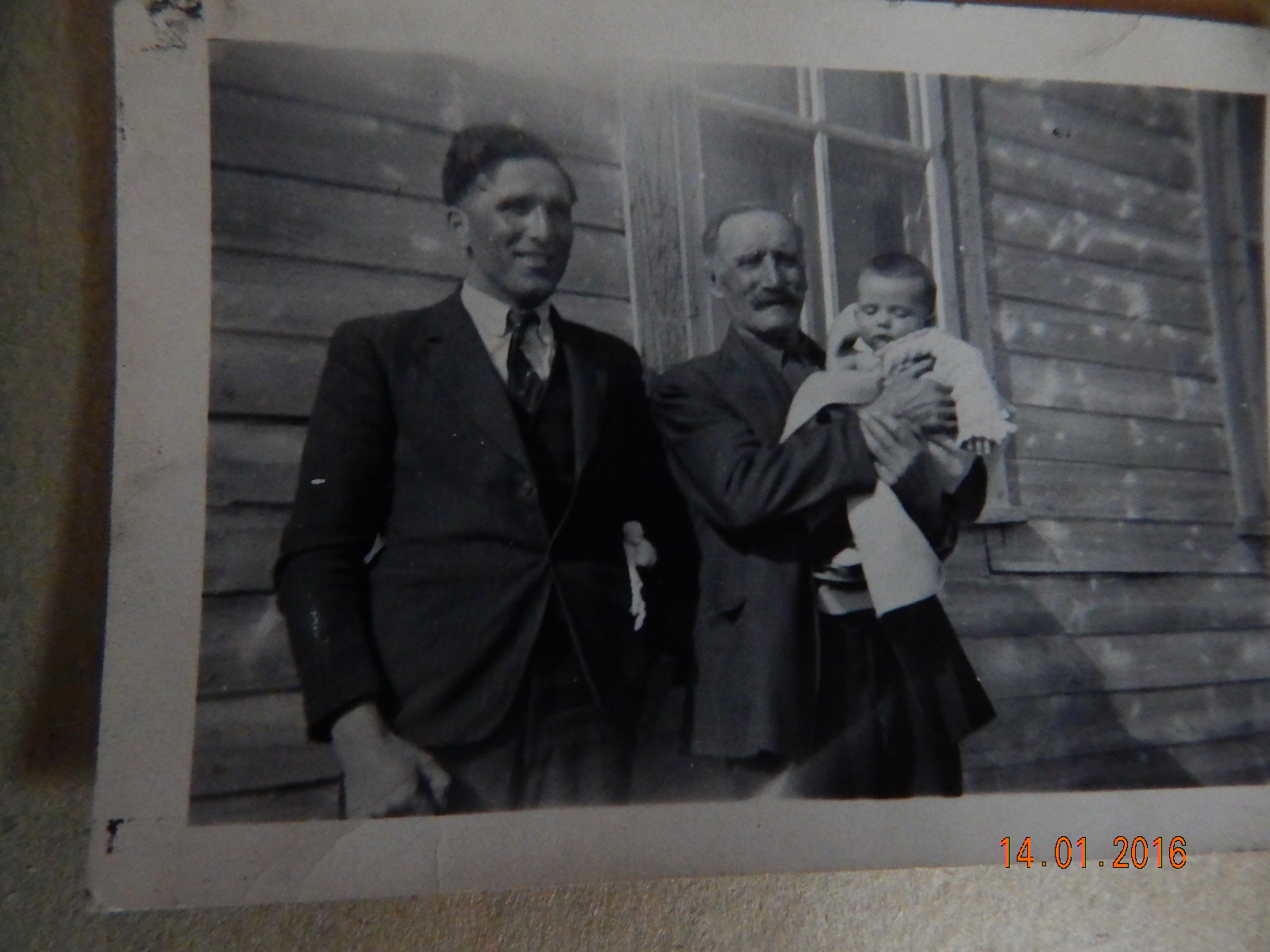
Wednesday, January 13, 2021

EMIL KLINE 2

     Dad worked around the Vernon, British Columbia area for about 5 years. In 1935 he was 22 years old. 

      For some reason he was not happy being a Lutheran. He was searching for something else and I don't think he knew what he was looking for. Somehow or other he found the Plymouth Brethern or they found him. He joined them and worshipped with them the remainder of his life.

     In 1935 he came back to his home in Esk, Saskatchewan. He bought a small farm. Where he got the money from to buy the farm I have no idea. His oldest sister came back with him and they farmed the summer of 1935. It may have been his sister's money that was used to buy  the farm. He went away in the winter to work at Portage la Prairie, Manitoba. 


     The young farmer

     He came back in the spring of 1936 to his farm. He had four horses but they were left out for the winter. In the spring he had to find his horses. Most farmers let their horses go for the winter and there would be huge horse herds in the area. 

     Love found my Dad in 1937. He married Mom in Feb. 1938. Many weddings were very small so they were married in her Mom's house.


     Wedding photo

     In February they went back to Dad's little house on the farm. They travelled by train and a friend met them and took them home. The next day Dad went over and started a fire in the house and they moved in with the few wedding presents they had. 

     The story was always the same. They had $60.00 and that had to last until September when they would have some grain to sell. So Dad promptly lost his wallet in the field with the $60.00 in it. They looked for hours. On the way back to the house Mom found the wallet. 

     From that time on they stayed on the farm.

     Another surprise happened in 1939 when I was born. 

     The war started and slowly Dad expanded with farming and the grain prices increased. 

      Another surprise happened in Oct. 1940 when my brother was born. My sister was born in 1942.

     They had a very small house and it was in very poor shape. Another boy was born in 1942.   

Monday, January 11, 2021

EMIL KLINE

       My Dad, Emil Kline, was born on the homestead in 1912. They'd been on the homestead for seven years but he often said he missed it. He wished he had been old enough to be a pioneer like his Dad or grandparents.

      However my Dad always said he had a good childhood. He had two older  brothers who worked on the farm so Dad had more time to play with younger siblings. He also helped his mother in the yard. He carried water by pail to her garden. He looked after chickens, weeded the garden and brought wood into the house.

      The one room country school was on their farm and only about 400 m from their house. Dad liked school and considered himself a good speller. For some years he was paid 15 cents a day to light the fire and have the school warm by the time kids got there. His sister was paid 10 cents a day to sweep the floor. 

    The economy was good in the 1920's and many of the pioneer's children pursued higher education and left the farm. Dad was in gr.10 in 1928-29. He boarded with a farm family who lived right beside the town. He did farm chores in exchange for his board and room. Apparently most of his gr 10 consisted of playing pool. As a result he did not do well in Gr. 10. We all know that the depression began in 1929 so that was the end of his education. 

     He worked on a farm for the summer and fall of 1929. He didn't want to go home and stay on the farm with his parents so he took a train to Grand Prairie Alberta and lived with an uncle and his cousins. His uncle had a small sawmill so they sawed lumber and brought in more trees to saw up. In the spring of 1930 Dad knew he had to move on as his uncle had enough kids to look after. . He asked his uncle for money and the uncle pointed to a pile of lumber and said that's your pay. The uncle couldn't sell lumber so how would a 17 year old kid sell lumber so Dad moved on. 

    Sometime during this time he decided to change the spelling of his name. More on the spelling later. 

    His next move was to the Okanagan in British Columbia. He had two sisters in the area and an uncle. He picked up work where ever he could. He worked on a dairy farm, picked apples, cut timber, and worked in a saw mill. When He didn't have work he had to be creative to find a place to live. For a while he lived in a wooden granary on someone's farm yard. 

     Dad said he was happy through this period of his life as he said none of them had money so they were all the same.

Friday, January 8, 2021

CHRISTIAN KLEIN

        Christian Klein was born in the mid 1860's in Wischegrad colony , Russia.  He was the oldest son of Gottlieb Klein. Christian was married to Caroline about 1899.  Christian was my grandfather.

        For that time it was unusual for a man to be married in his early 30's. We do know that he was in the Russian army. It's not known how long he was in the Russian army.

        Much of his life is the same as Gottlieb's life. 

        Christian acted as the night watchman in the colony. It's not known how much farming he did. 

       Christian came to Canada in 1900 with his wife and oldest daughter. Three and possibly four children died in early childhood. I know that one lived to be two years old. As a result Christian's children were born later in his life. They had twelve children and eight of them lived to adult hood and some of them lived to be  very elderly.  My Dad was born when Christian was 44 years old.

     Christian  , his wife and two daughters came to Esk , Sask to claim a homestead and begin farming. Life was very challenging in the first years of homesteading. Since there was no railroad, they couldn't sell any products so they had very little money. A railroad was built about three miles from his farm in 1909 and then he was able to sell grain and get some cash. 

      The 1920's were boom times. They were able to borrow money and buy machinery and build some good buildings.  1929 came and they were not able to make payments on the mortgage. Christian and his sons worked together and were able to cover mortgage payments and keep the farm. It was a from rags to riches and back to rags again. 

      I was Christian's first grandson and he was 71 years old. 


      Christian stayed on his farm with his youngest son until he was 78. He then retired in the small village of Esk with its  25 people. His wife Caroline died in 1948. As for most men of that age they knew nothing about housekeeping and he didn't do well. He then began spending part of each year with his sons. So I remember living with Grandpa. As kids we liked our grandpa and he liked us. We talked back and forth. It wasn't until much later in life that I was told that he never learned to speak English and of course we didn't speak German. He could understand enough English and we understood enough German to communicate quite well. 

       He died in 1959 . 

Monday, January 4, 2021

TRAVEL TO THE HOMESTEAD

      One thing I like about blogging it the questions that appear in the comments. As a writer there are often things I do not include. A good question reminds me to fill out the story.

      I think two of the men had been out to the area the year before . A Mr. Jansen from Nebraska helped them find land. 

     A question was asked about transportation across the prairie. The move from Manitoba to Esk , Sask was about 700 miles. By 1905 , when they moved , some railroads had been constructed. So they were able to get within 40 miles of their homesteads by rail. 

     The railroad gave the homesteaders a good deal on freight. So  a person could get a boxcar and put all their belongings in it for transportation. So an amazing amount of freight could be crammed in one box car. So here's the list: machinery, household effects, clothing, a couple of horses , a cow, a few pigs and chickens, some seed grain , farm tools. 

     One person would be allowed to ride in this freight car so that when the train stopped the animals could be taken off to be fed and watered. Sometimes a second person would be sneaked into the freight car but this was risky as there were police watching for this activity. There are many stories about people hiding amongst the freight.

    The remainder of the family would travel as passengers. 

    When the train got to Watson ,Sask. the car was put on the siding and unloaded. Women and children stayed  with some of the freight while the men hauled material to the homestead. They went to their homesteads following some trails. They didn't have a map but there were survey stakes the could be used to tell where they were. 

    The men put up shelters and went back for more freight and family. 

     They worked hard to put up a house for the winter. Three types of houses were built. There were some trees that were big enough to make a log house. Some homesteaders built a sod house and some  clay house. 

     There was not much variety for food. They seeded some potatoes. They had eggs. meet was supplied by game that was taken. A few groceries were bought such as flour and a few other staples. 

    It was a very difficult journey and new life but they knew that it would be better than what they left. 

Friday, January 1, 2021

CHALLENGES

      One thing I forgot to mention in the last post where they were self sufficient and made most of their needs is that there was always someone who could make very good wine and beer. They didn't have laws about making spirits so that the government was able to tax them.

     My last post consisted of some research about the German emigration to Russia.

     Before I go any further , I must say that I'm grateful to Virginia Beihn for writing many stories down. Gottleib lived with them for about 15 years. Virginia was his granddaughter. Virginia passed away in 2012.  I am also grateful to Carollynn Leggott who has tirelessly worked on the genealogy. It's amazing what she has found. 

     Before I move on I described the clay houses they lived in. I'm assuming that somehow lumber wasn't available or was too expensive. The clay house was much warmer than a lumber house. If the clay house was properly maintained it would last 50 years or more. Walls inside were painted with calsomine every year so the inside was pleasant. 

      When Gottleib came to Manitoba he found some land to farm. Information I have says he came in 1889 but I don't think that is correct. He built a very small wooden house. I guess there was lumber available and he liked the idea of a wooden house. Wooden houses built at that time were very, very cold. They had two ply of lumber. The lumber dried and left cracks for the wind to blow through. 

     Later they found homesteads at Esk , Sask and all of them moved there in 1905. Homesteads were a government promotion to bring settlers to western Canada. A person would pay $10.00 and be given 160 acres of land and if they did certain improvements in three years it was their land. Gottleib took his little wooden house apart and took it to his homestead where he put it together again. Gottleib was 63 years old so he was quite old to begin farming in a new area. 

     Gottlieb was a leader. He brought all his children and their in-laws to Canada. They moved to their homesteads ahead of many necessary parts of a community. There was not railroad in the area. He was a devote Lutheran. He held church services in his house . He baptised babies and conducted funerals until a church was built and a minister began coming to the area. He donated the land for a cemetery. 

   I always wondered why Gottleib never had any brothers or sisters here. Why didn't he bring other relatives. I found out that he was the only one in his family who survived. He had two sisters who passed away in their 20's. 

     His wife died in 1911 and he went to live with his daughter. His little house was moved to his daughter's yard and used as a small shop for repairing harness. Later it was used by his son-in-law to make furniture...mostly rocking chairs. Today that little house is in a museum at Humboldt, Sask. 

    Gottleib died in 1929. He had the ability to look at a sick horse and the horse would get better. The day before Gottleib died they brought a sick horse to the back steps for Gottleib to look at. The horse got better but Gottleib died. This talent was believed to be passed from one generation to another alternating from male to female. 


Wednesday, December 30, 2020

Gottlieb Klein

        Our family origin is from the Germans who went to Russia in the 1700's.

        During he 1700's economic and government conditions were very poor in Germany. They had the Seven Years war which had created much economic and social chaos. Security was limited. There was no central government. 

      Along came an offer many Germans could not refuse. Catherine II of Russia invited Germans to areas of Russia that were sparsely populated. Her idea was that these areas could be settled and developed. The Germans were given free land, self government, could keep their own language and religion, were given loans that were forgiven , no military service as they were pacifist and could leave Russia at any time.

      We don't know when the Klein family left Germany. They were the Germans who settled on the Volga. 

       All went fairly smoothly for about 100 years. They became successful farmers and traders. There were some problems. Marauders robbed them from time to time. Crops were not always successful.

      These people were peasants. They were given about 40 acres of land. Most of the work was done by hand. Some people had a horse that was used by several farmers. They had some farm animals. They grew crops , vegetables and some fruit. 

      Their houses were built of clay and probably had a thatched roof. They had dirt floors. These houses were warm in the winter and cool in the summer. 

     They had very little money . They were able to sell some of their produce but most of it they used for themselves. They milled flour from their grain. They grew many vegetables. They grew lots of cabbage that was turned into sauerkraut as this would keep for the year. So some people had businesses as in milling grain. Leather was produced and used to make their shoes. Wool was spun and some weaving was done. Very little was bought. 

    They were happy with this life. After Catherine II they gradually lost some of the rights they were first given. They first lost some of their independent government. Things were slowly taken away. My Grandfather was in the Russian army for two years. 

    Many Germans came to North America starting in the 1870's . Our family began coming to America in the late 1890's. Grandfather Gottlieb was born in the 1840's and brought all his adult children to America. Gottlieb had three daughters and four sons  who were all married. Gottlieb was about 60 when he came here so some of his grandchildren were also married. Over a period of ten years the whole family left Russia. They came to Manitoba , Canada and North Dakota . USA. Mennonites had given them some aid to make the trip to America. So when they first came some of the Kleins worked on farms to payoff their loans.

     Borders were not big deals in those days as some of them lived in Canada and some in the USA. Some of them lived at Neche North Dakota and some at Gretna Manitoba.

To be continued...


Sunday, December 27, 2020

MORE AGES AND STAGES

      A few posts ago I thought about how I'm in my eighties with some great ancestors. I had photos of my Dad on his 80th birthday, and my Grandpa when he was about 84.

   I also said that I would like to get the three of us in one photo but I didn't know how to do that. My friend , Bill saw this and couldn't resist so sent me a photo of the three of us in one photo. It's done by melding. Then I found a photo of another guy...my great Grandfather. 

     So here is the first meld. 


Then I thought , I wonder if Bill would put the four of us together.


So here we are! Great Grandpa is on the right at about 84. It is difficult to meld there are four different types of technology in making these photos.

     So next I will do some short biographies .